Billy The Kid In The Theater Of Blood | Todd Moore
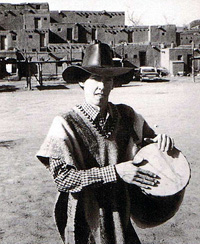
I am staring at the cover of a pure Outlaw classic, just published by the Outlaw Press in Pueblo, Colorado. It’s perfect bound, with signature black depths and striking yellows and reds all across it. The surreal figure wearing the big cowboy hat and poncho is Tony Moffeit and the title of this book is BLUES FOR BILLY THE KID. There is no price on the cover simply because this book is, according to Moffeit, one of a kind, not for sale.
While all books written by Outlaw Poets are one of a kind, this one really is just the one. Moffeit, who has long been known for his fascination with Billy the Kid has published this book on his own press and is giving it away to close friends, tells me that BLUES FOR BILLY THE KID is still a work in progress.
I suppose the question that Moffeit may be asked is if this book is unavailable to the reading public, then why bother to review it? After all, aren’t book reviews written to sell books? My answer is that it is becoming less and less the case. It probably works for mainstream publishers but book reviewing for small press books really has little to do with money. The purpose it accomplishes for a poet like Tony Moffeit is really to announce the fact that an important book has been released to reviewers and critics regardless of the print run. I say important book because BLUES FOR BILLY THE KID is an important book. Important because it joins other important books such as A HORSE CALLED DESPERATION, PLAIN OLD BOOGIE LONG DIVISION, ADVENTURES IN THE GUNTRADE, and DILLINGER as landmark narratives in the Outlaw Generation.
Since the mid to late seventies, Tony Moffeit has made a name for himself mainly as a poet and a pop culture critic. His bluesy poetry performances have electrified audiences around the country for years. However with the publication, and use the word publication with the broadest possible application, of BLUES FOR BILLY THE KID, Moffeit is now stepping up in the role of long narrative writer, more so than ever before. BLUES might easily be called a long poem. The format of his long lined page is very similar to an earlier Moffeit poem like Luminous Animal. The difference, however, is that each section of this work is divided into discrete chapters which make me believe that Moffeit’s BLUES is really meant to be a novel. I don’t think I would be far off the mark to call it a novel-in-progress.
And, I am already anticipating those critics and readers who might say, but what about the length and where are the well drawn characters? As for the length, I estimate it to be somewhere around eight to ten thousand words long. As for the characters, all characters are emanations of the writer’s demon obsessed self and night bound other. The clearest drawn character is Moffeit himself or the Moffeit narrator. The elusive other is actually the Kid.
One thing to keep in mind about the novel as a form. It has never been clearly defined as a form. It varies from writer to writer. Breton’s NADJA is as unique as Hedayat’s THE BLIND OWL. The characters are not all that well defined in either book. Or, take Michael Ondaatje’s THE COLLECTED WORKS OF BILLY THE KID which is part prose, part poetry and is often classified as a work of poetry. A classification I totally disagree with. It’s definitely a novel and not a very long one at that. My estimate that it’s barely twenty thousand words long. And, while length is really only a quibble with regard to the novel, lets recall that some of the great novels have barely exceeded thirty thousand words. Those would include THE STRANGER, THE OLD MAN AND THE SEA, and THE HEART OF DARKNESS.
While BLUES FOR BILLY THE KID is a novel, it is at this point still a work in progress, so who knows what its final length will be. What I do know is that it is a novel of rare and hypnotic power as it stands. I like to think that poets’ novels have a quality I tend to equate with heavy water used in the production of nuclear weapons. A poet’s novel is dense with suggestion, metaphor, dream, and nightmare. I think this idea might as easily be applied to THE BELL JAR, DOCTOR ZHIVAGO, DELIVERANCE, or THE CARDBOARD HOUSE. At any rate, those certainly are the qualities to be found in BLUES FOR BILLY THE KID. Kid novels in america are anomalies, wormholes of fiction, images of extreme and mysterious notation, snapshots from the void. The most accessible ones are those that appear as pulp westerns, too numerous to mention. Serious writers such as Larry McMurtry, M. Scott Momaday, and Michael Ondaatje have each taken a turn at writing about the Kid. And, even in BLOOD MERIDIAN there is a character called the Kid and while he is not meant to be the historical Billy, the suggestion is still there that he is a cubist fragment, a fly away shadow of old Billy Bonney.
While many have written thousands and thousands of words about the Kid, nobody really knows who he was or what he was like. I personally came to this conclusion while writing my novel DREAMING OF BILLY THE KID. And, during the course of my research into the adventures of the Kid of all kids, especially talking to other novelists who have written extensively about the Kid, I reached the conclusion that the Kid never really knew the Kid. How can anyone, especially a famous outlaw ever know the legend, the myth, and the origins of his own personal darkness?
The Kid was the Kid and each and every poet and novelist who approaches this mystery eventually comes away with the knowledge that the Kid is that impenetrable darkness which can only be guessed at but really never breached. After all the bare bone facts are known and the speculations made, the only thing a novelist or a poet can do is dream. But the dream must be made as a wager and the wager is always done with the blood.
Which is what I think Moffeit has done. BLUES FOR BILLY THE KID is on its way to becoming one of the essential books of the Outlaw Revolution. If anything this novel is as much an attempt to conjure the Kid right out of the dust as DILLINGER is an attempt to rescue John Dillinger from the blood splattered alley near the Biograph Theater. Think of Moffeit’s act of writing it as the equivalent of Maria Sabina performing one of her Veladas to cure someone. Maybe himself. Or, Black Elk’s attempt to call back the buffalo. And, no, Tony Moffeit is definitely not a shaman. Not in the old primal sense of the word. But Moffeit is an Outlaw Poet painting his fragmented novel the way that Picasso painted Guernica. Moffeit is a primal poet somehow trying to conjure an outlaw america, to shore it up against future Enrons and Abu Ghraibs, trying to piece it all together as some kind of answer to what passes for the bankrupt poetry of the mainstream presses, as some kind of reply to the shit that passes for great art today. A book like BLUES FOR BILLY THE KID is an american death song. I salute him from the theater of blood.